
An internal locus of control is associated with improved mental health, greater professional and personal success, and a higher degree of personal responsibility and leadership qualities. For those of you who aren’t familiar with the concept, a locus of control essentially means how you attribute the outcomes of your actions. If you view the outcomes of your actions as contingent on what you do, then you have an internal locus of control. If you view the outcomes of your actions as being contingent on environmental factors, then that is viewing things with an external locus of control. People with an external locus of control blame others for the things that happen, they often credit much to fate, and they in general often suffer from a greater feeling of helplessness.

The image to the right provides a great illustration of these two approaches. There is, however, an inherent bias present in the way people often talk about locus of control, and this can be seen even in this image.
As is clear from the illustration, and perhaps even the introductory paragraph of this article, the prevailing attitude is that an internal locus of control is superior in every way to an external locus of control. In the scope of this article, a case will be made for why, perhaps, neither approach is “better”, they are simply different, and that perhaps a blending of approaches would in fact be the ideal. Let’s explore further.
It is more empowering to view one’s actions through a lens of having complete control. We do, generally, have a high degree of control over what we do, after all. If we hold ourselves to task and believe that we can and do direct ourselves consciously then not only are we more likely to move in a deliberate and planned way, but we are more likely to resist temptation, exercise willpower, and overall make good decisions.
But what about for individuals with behaviour and mood disorders, or other mental health issues or personality disorders? For these individuals, their autonomy is somewhat out of control at times, and the attributing of blame for poor decisions or even poor behaviour can be detrimental. Even in individuals who suffer no discernable psychological disorder, we are all prone to making poor decisions at times and to attribute the full weight of those decisions to internal factors can be detrimental to one’s self-image, general state of well-being, and overall happiness. Certainly, taking responsibility is crucial and helps in making good decisions, but the danger lies when that responsibility turns to blame and can cause an individual to descend into a cycle of shame and depressive thoughts.
With that said, there is a large body of evidence that a higher degree of an internal locus approach can help individuals suffering from psychological disorders to manage and even control some of the ill-effects of their conditions. So, in short, by being flexible with how we view our locus of control, we can maximize the benefit to our state of mental state and well-being.
This actually has a name already that many of us are aware of. An optimistic attributional style is associated with an individual who credits their successes to internal factors, and dismisses failures as being influenced by the external. A pessimistic attributional style on the other hand is often associated with the exact opposite of this, where an individual thinks of their successes as dumb luck or influenced externally and their failures as being caused by them, the thought of “I never do anything right” is a prevalent one in those who take this style. People who use pessimistic attribution are often prone to depression, whereas those with an optimistic style often overcome missteps more easily and enjoy increased success.
Of course, there is a danger in never accepting responsibility for one’s failures, especially when they are truly caused by some misstep that could be learnt from. In fact, there is a noted cognitive bias that describes just this danger if the propensity to never acknowledge one’s mistakes develops, and this is aptly called the Self-Serving Bias. Therefore, it is important not to become rigid with how we view the locus of control but to simply be willing to attribute things as is appropriate and so long as it fits with the reality of the situation.
This brings us to the next point regarding the locus of control. Sometimes things are outside of our control. So far we have discussed how our own decisions can be viewed through either lens so as to maximize our control and also to protect our mental state. But what about when true external factors affect our success?
For instance, say that you have decided you want to become a triathlete. Say that you do everything right, and that you follow a training regiment, you eat right, you seek out expert opinions and advice, and you utilize all the resources at your disposal correctly to prepare you for this path. Then, after months of training and anticipation, tragedy strikes an you are hit by a vehicle running a red light while you are riding your bike. Terrible? Yes. Your fault? Not in the slightest. Now, to recover from this tragedy, embracing an internal locus will help, but in reflecting on the tragedy, embracing an external locus is best.
By focusing internally on your recovery, “I can do it”, then you can regain what was taken from you. But by focusing internally on the cause of your injuries, “I wouldn’t have been out there if I hadn’t decided to train”, you will only fall into a cycle of self-blame and regret. By shifting the focus on the cause of the situation to an external cause, “that driver made a terrible mistake”, maybe even, “that driver is an ass”, there is a degree of empowerment there. This can apply to many situations in life where true external factors come in and derail our plans. By setting the unrealistic illusion that we have complete control we can begin to blame ourselves for things that were truly outside of our control. By being able to attribute these factors where they belong, and focus on how to redeem situations by taking responsibility, it is possible to create the best and most realistic approach overall. We can control much of what we do, but to accept that somethings are outside of our control and not beat ourselves up for them seems to clearly be the ideal.
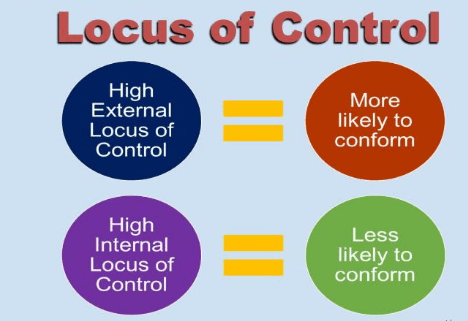
Finally, let’s explore one more small aspect of locus of control. The graphic to the left illustrates how locus of control affects conformity. Conformity has become a sort of buzz word with a negative connotation. However, let us remember we live in a society with rules and laws and economy and we all conform to one degree or another.
Without conformity, we would have chaos. Society with all its inherent flaws still provides a general level of comfort that most of us appreciate even if it means that we have to get up and work a 9-5. Sure, having independence and individuality is great when it comes to visionaries and leaders, but there is a danger in there being too widely spread and rampant of a propensity to rebel just for the sake of rebelling. Rebellion without vision and without forethought is anarchy, and anarchy, true anarchy, is often worse than any system of government and order, save the most fascist. There is nothing more dangerous in this world than the completely self-assured idiot with an inflated sense empowerment. With that said, there are times when society is wrong, when injustices and power structures must be stood up to, and when rebellion and protest is completely appropriate and even vital. This is why once again we must use a blended approach.
Ultimately, there is an inclination in our society to view so many things that exist on a spectrum between two extremes as one way or the other. In general, a blending of approaches would provide the best outcome, and the loci of control are no exception to this, if anything they are a shining example of why this is true. It certainly is easier to say, “this is the superior way”, but in life there is rarely a one size fits all answer. The answers are nuanced, they’re complex, and we must constantly exercise our best judgement when applying them to the problems we face because the problems themselves are often unique. If we are to become the masters of ourselves and our destiny truly, then we must exercise all of our cognitive an metacognitive faculties and tailor our approach to life. This is why a blending of approaches of loci of control is not only reasonable, but is in fact imperative to our health, happiness, and direction as a species.
 Bloody Well Write